

If you're a digital nomad working from European cafés and coworking spaces, you've almost certainly encountered the Schengen 90/180-day rule. On the surface it seems straightforward: you can spend 90 days in the Schengen Area within any 180-day rolling window. But the “rolling” part trips up even seasoned travelers, and the consequences of getting it wrong are serious.
The 90/180 Rule: Not as Simple as It Sounds
Unlike a fixed calendar period, the 180-day window moves with you. Every single day, a new window is calculated backwards from that date. Days you spent in the Schengen Area during that window count toward your 90-day limit, and they only “roll off” once they fall outside the current window.
Here's where it gets tricky: both your entry and exit dates count as full days. A quick weekend trip from Friday to Sunday uses 3 days, not 2. And if you're hopping between Schengen countries, like flying from Lisbon to Berlin, those days all count toward the same 90-day pool. There's no separate allowance per country.
For digital nomads who spend months at a time in Europe, moving between cities and countries, this rolling calculation becomes genuinely difficult to track manually.
Why Spreadsheets Fail
Many nomads try to track their days in a spreadsheet. You add your entry dates, exit dates, manually sum the days, and hope your formulas are right. But spreadsheets can't easily model a rolling window. They don't warn you when you're approaching your limit. And one miscounted day can mean the difference between compliance and a visa violation.
The stakes are real. Overstaying can result in fines, deportation, or even multi-year entry bans. When you're bouncing between Lisbon, Berlin, and Barcelona, the last thing you want is manual date arithmetic standing between you and legal compliance.
Even worse, spreadsheets give you a snapshot of today. They don't answer the question every nomad actually needs answered: “If I book this trip next month, will I still be compliant?”
See Your Schengen Days, Visually
This is exactly why we built the timeline visualization in Schengen Monitor. Instead of staring at rows and columns, you see your stays laid out on a visual timeline, color-coded with clear indicators showing how many days you've used and how many remain.
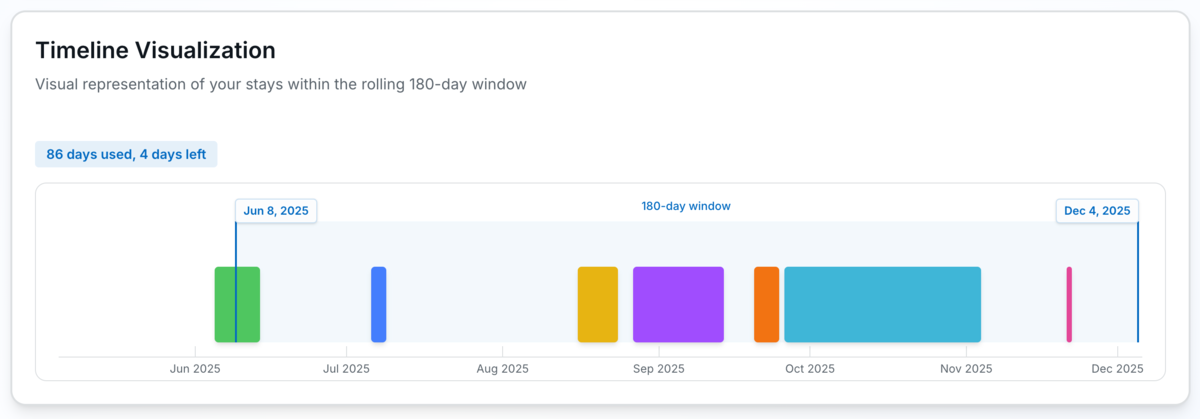
You can add proposed future trips and immediately see whether they'll keep you compliant. The calculator does all the rolling-window math in real time, so you always know exactly where you stand. No formulas, no guesswork.
The core calculator is completely free and works without an account. Your data stays in your browser. If you create an account, your stays sync across devices, which is handy when you're checking on your phone in an airport and planning on your laptop later that evening.
Planning Your Exit Strategy
Every digital nomad in Europe eventually faces the question: “When do I have to leave?” With the timeline visualization, the answer is immediately clear. You can see the exact date your days run out, plan your departure accordingly, and experiment with different return dates to see how they affect your balance.
This kind of forward planning is invaluable. Instead of a stressful last-minute scramble, you can book flights weeks in advance, often at much better prices. You can also coordinate with other nomads, book coworking spaces, and line up accommodation without the anxiety of “am I even allowed to be here?”
The proposed trips feature is especially powerful here. Add a hypothetical return trip and the calculator instantly shows you whether it works within your remaining balance. Adjust the dates until you find the sweet spot.
Where to Go When You Need to Reset
When your Schengen days run low, you don't have to go far. Some of the best “reset” destinations for digital nomads are right next door, outside the Schengen Area but with great infrastructure for remote work:
- United Kingdom: London's tech scene and countless coworking spaces make it a natural choice. Edinburgh and Manchester are more affordable alternatives with strong nomad communities.
- Albania: Tirana has become a digital nomad favorite. Affordable cost of living, beautiful coastline in the south, and a growing number of coworking spaces. Plus, most nationalities can stay up to a year visa-free.
- Montenegro: Stunning Adriatic coast with a low cost of living. Budva and Kotor offer reliable internet and a relaxed pace of life.
- Turkey: Istanbul straddles two continents and delivers world-class food, culture, and coworking infrastructure. Antalya is another popular nomad base.
- Georgia: Tbilisi has emerged as one of the world's top digital nomad hubs, thanks to its one-year remote worker visa, low cost of living, and vibrant expat community.
The key is knowing exactly how many days you need to spend outside the Schengen Area before your days start replenishing. That's where the timeline makes all the difference. You can see precisely when each day “rolls off” and plan your return accordingly.
Getting Started
If you're a digital nomad spending time in Europe, or even just planning to, start by adding your past Schengen stays to the calculator. It takes a few minutes and immediately gives you a clear picture of where you stand. From there, use the proposed trips feature to plan ahead with confidence.
No more spreadsheets. No more guesswork. Just a clear, visual answer to the question that matters most: “How many days do I have left?”