
Nobody plans to overstay their Schengen visa. It usually happens gradually: you extend a trip by a few days, lose track of a weekend border hop, or simply miscalculate how the rolling window works. But the consequences can follow you for years, and in some cases, they can end your ability to travel freely in Europe altogether.
Here's what actually happens if you overstay, what the penalties look like in practice, and most importantly, how to make sure it never happens to you.
What Counts as Overstaying?
You're considered to have overstayed if you spend more than 90 days within any 180-day rolling window inside the Schengen Area. The key word is “rolling.” This isn't a fixed six-month period that resets on a calendar date. Every single day, the window recalculates by looking back 180 days from that moment.
This means you can't simply leave for a week and “reset the clock.” Your previous days in the Schengen Area only stop counting once they fall outside the current 180-day window. It's this rolling nature that catches most people off guard.
And remember: both your entry and exit dates count as full days. A trip from Monday to Friday is five days used, not four.
The Real Consequences
The penalties for overstaying vary by country, but they're universally unpleasant. Here's what you could be facing:
Fines
Most Schengen countries will issue a fine when they detect an overstay, typically at the airport when you're trying to leave. These fines range from a few hundred to several thousand euros depending on the country and how long you overstayed. Germany, for example, can fine up to €5,000. Spain and Italy have similar ranges.
Entry Bans
This is the one that really hurts. An overstay can result in an entry ban to the entire Schengen Area, not just the country where you were caught. Bans typically range from one to five years, though serious or repeated violations can result in longer bans. During this time, you won't be able to enter any of the 29 Schengen countries.
Deportation
If your overstay is discovered while you're still in the country, you can be detained and deported. This goes on your record and makes future visa applications to any country significantly harder. Some countries will also require you to pay for the cost of your own deportation.
Future Visa Problems
Even if you avoid fines and bans, an overstay on your record makes future visa applications much more difficult. Consulates share information through the Visa Information System (VIS), so an overstay in Portugal will show up when you apply for a visa to France. Many travelers have had subsequent applications rejected entirely because of a past overstay.
How Overstays Get Detected
Some travelers assume overstays go unnoticed. That used to be more true, but enforcement has tightened considerably. Here's how they catch you:
- Exit passport control: Border officers check your entry stamps and calculate your days. This is the most common point of detection, usually right as you're trying to fly home.
- Entry/Exit System (EES): The EU's new digital border system is replacing passport stamps with biometric records. Once fully rolled out, it will automatically flag overstays in real time, making it nearly impossible to slip through.
- Random checks: Police in some countries can ask to see your passport and check your legal status. This is more common in certain countries than others, but it does happen.
- Future visa applications: Even if nobody catches it at the border, an overstay will surface when you apply for your next Schengen visa. Consulates can see your travel history.
Common Mistakes That Lead to Overstays
Most overstays aren't intentional. They come from genuine confusion about how the rules work:
- Thinking it resets after 90 days out: The 180-day window is continuous. Leaving for a short period doesn't give you a fresh 90 days.
- Not counting entry and exit days: Both count. A “day trip” across a border still uses a day from your allowance.
- Losing track across multiple trips: Three separate two-week trips feel short, but that's already 42 days gone. Add a longer stay and you're suddenly cutting it close.
- Confusing Schengen with EU: Not all EU countries are in Schengen, and not all Schengen countries are in the EU. Time in the UK, Ireland, or Cyprus doesn't count toward your Schengen days, but time in non-EU Schengen members like Norway and Switzerland does.
- Relying on mental math: The rolling window calculation is surprisingly complex. What feels like “plenty of days left” in your head might not hold up when you actually run the numbers.
How to Make Sure You Never Overstay
The good news is that overstaying is completely avoidable if you track your days properly. Here's how:
Record every stay. Every trip into the Schengen Area needs to be logged, no matter how short. A weekend in Paris or a layover in Amsterdam where you pass through passport control all count. Get in the habit of recording your entry and exit dates as soon as each trip happens.
Use a proper calculator. The rolling window math is not something you should be doing in your head or in a spreadsheet. A purpose-built Schengen calculator will handle the calculation correctly every time and show you exactly how many days you have remaining.
Check before you book. Before committing to any trip, add it as a proposed trip in the calculator to verify it won't push you over. This takes seconds and can save you from a very expensive mistake.
Visualize your timeline. Numbers in a table are easy to gloss over. A visual timeline of your stays makes your situation immediately clear. You can see at a glance how your days are distributed, when old days will roll off, and exactly when you need to leave if you're running low.
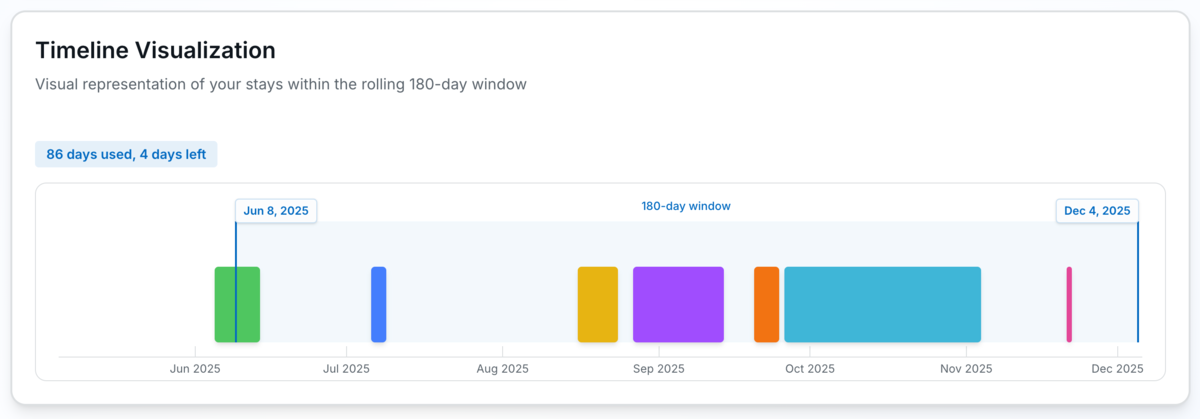
Plan your exits early. If you know you'll need to leave the Schengen Area, don't wait until the last minute. Book your departure at least a couple of weeks before your days run out. This gives you a buffer for unexpected delays and usually means cheaper flights too.
What to Do If You've Already Overstayed
If you realize you've overstayed, don't panic, but do act quickly. Leaving voluntarily is always better than being discovered. The longer you stay past your limit, the worse the consequences.
Be honest at passport control. Trying to avoid exit checks or using alternative routes to dodge detection will only make things worse if you're caught. Some border officers are more lenient with travelers who are upfront about a short, accidental overstay.
If you believe you have grounds for an extension (serious illness, force majeure, humanitarian reasons), contact the immigration authority in the country you're in before your days run out, not after. Extensions are rarely granted, but applying proactively looks far better than being caught after the fact.
Stay on the Right Side
The Schengen 90/180 rule exists to regulate short-term visits, not to trap well-meaning travelers. But its rolling-window design makes it genuinely easy to miscalculate, especially if you travel frequently or stay for extended periods.
The simplest way to protect yourself is to track every stay, check every trip before you book, and keep a visual eye on your timeline. A few minutes of tracking can save you from fines, bans, and the stress of wondering whether you're still legal.
Start by adding your past stays to the calculator. It only takes a few minutes, and you'll know exactly where you stand.